
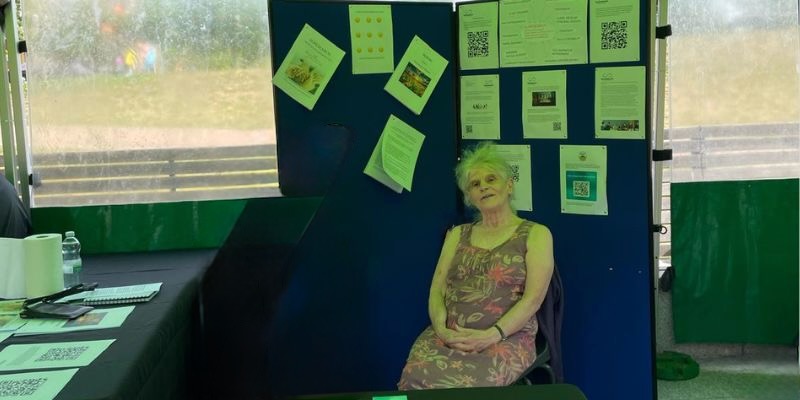
Barbara has been a member of Suresearch for many years. This autobiographical contribution, which includes experiences of Suresearch, was written and shared at the University of Birmingham community day in June 2025.
“I have lived in England since 1961. I came here, with my parents, after we’d been living in Germany for 3 years. Before that, we lived in America, but I was not born there.
My mother gave birth to me in Munich, Germany, in March 1947, by Caesarian Section. Both of my parents were in Munich for a while, because my father was involved in a magazine set up in Germany by the US Army, after the 2nd World War. We returned to the US in October 1947, when I was still a baby. Both my parents were in their 40s, and I was the only child.
My mother was born in 1906 at Farmer City, Illinois, to an Irish American family. My father was born in 1905 in London, to a German Jewish family. The family returned to Germany before World War 1, but they had to leave Germany before World War 2, because so many Jews were being tortured and killed in concentration camps by the Nazis. In order to survive, they went to America.
Mum was a violinist, and was playing in trios, quartets and concerts for at least 20 years. She did not want to marry for a while, because at that time a woman could not have a career and be married. But in her late 30s, she met my dad, while she was teaching violin at a college in South Carolina — and while he was recruiting and training young men to join the US army.
I had a difficult relationship with my dad because he was so direct and straightforward — I thought he was telling me off. He asked me if I thought I had “childhood schizophrenia”, based on a book he’ was reading when I was 10 years old, and he also said to me “Barbara — strange woman”. More recently, I think I know what caused this.
I spent 4 years in London before I went to Oxford University. I became fascinated with psychology and psychiatry and psychoanalysis, and I read some books by Sigmund Freud and Carl Jung, also by Wilhelm Reich. But while I was at Oxford University, aged 18 -21, I had difficulties keeping up, because I felt very low. I was sent to a psychiatrist, who diagnosed me with anxiety and depression. I could not achieve an Honours degree — I was given a Pass degree.
After leaving university in 1968, I involved myself in campaigns about homelessness and mental illness, mostly in London. One, that was closer to Oxford, was led by Anton Wallich-Clifford, who found residence for the homeless. Another was Task Force, in London — young people helping older people.
The third one that I took part in was a group of people in London, who had mental health problems, and were helping others who had mental health problems. We did not call ourselves Service Users back then — or Experts by Experience — only patients. We were provided a house by the Greater London Council, where we could take care of those with mental health issues for a while, so that they did not immediately have to go into what was then called a mental hospital.
But after 4 years of being involved in this group, I began to have severe depression, and I was no longer able to be part of it, despite the fact that it was taking care of people like me.
I came to Birmingham in 1980, because of a relationship that began in 1977 with a woman living in Birmingham . This ended a while ago, but I still do like living in Birmingham. My first job here was in a bookshop called the Peace Centre, which was selling pacifist books — It closed after 6 years, along with other bookshops in the city centre. I couldn’t find a job for several years after that, so I received unemployment benefit — what is now Universal Credit. I could have told the Labour Exchange — what is now the Jobcentre — that I was having mental health problems, but I thought this would mean I couldn’t get a job, so I didn’t tell them.
A few years later, I got a job at Birmingham MIND, which had set up a number of care homes in the suburbs. I could work in the morning, or in the late afternoon and evening, when I would sometimes stay there overnight to take care of those who lived there. Then, In the late 1990s, I decided to get a social work degree at Birmingham University. But when it finished, I could not find a job in social work. At that time, when I was 53, women were retiring from their jobs at 60, and it may have been because I would only have 7 years to work — although the Waspis (Women Against State Pension Inequality) were protesting, because there was a difference between men’s and women’s length of working.
It was during my time at Birmingham University that I became involved with another mental health group — Suresearch — Service Users in Research and Education. It was begun by Professor Ann Davis, and a few more university lecturers, also by students who had experienced mental health issues. Other service users, who were not students, were invited to join us, and we involved ourselves in research about the way mental health was being dealt with, and people’s experiences.
We raised funding to keep us going — we are still doing this — and Suresearch has now continued for 25 years. We are meeting on the first Thursday of every month at Birmingham University. We have used several of the buildings at the University to do our monthly meetings — nowadays we are meeting at Park House on Edgbaston Park Road.
After leaving the university, I worked for MIND again, briefly — then, I was given a job at South Birmingham Mental Health Trust in 2003, with a service user group called User Voice A few years later, all the Birmingham Mental Health Trusts joined together, and included Solihull — it then became Birmingham and Solihull Mental Health Foundation Trust (BSMHFT) — as it is called now. I enjoyed working there for the first 8 years, but over the last 2 years, I began having difficulties. Fortunately, in 2013 I was able to retire, aged 66.
About 10 years ago, I met some local people who told me they were autistic, and I looked at the National Autistic Society website. The information on it suggested I might be autistic — not falling in love, not grieving for my parents or my partners who had died, not much liking comedy. Also: avoiding loud noise, having some difficulty with a conversation with more than one person, and being unable to “multi-task”. But I had to wait a while for the diagnosis that told me I really was autistic.
I believe I inherited autism from my father — back in the 1950s, there was not as much known about it as there is today. His directness could have been a feature of autism — I’ve had to learn how to be less direct when speaking to other people. Autism can also increase a person’s anxiety, because the mid-brain (the amygdala, which is involved in self-protection), is more closely connected to the intelligent front of the brain than with non-autistic people. This can cause more intense anxiety than what most people are experiencing.
This does explain my anxiety, and my depression, over the years. Despite that, and despite being on my own for most of the time, I have had a good life, and I believe that I’ve done a number of good things — in Birmingham, in London, in Germany (I was sent there for 3 months while studying social work), also in America, where my mother returned after my father’s accidental death in London in 1978. I went to see her there until she died in 2008, aged 101.
I don’t know if I will live as long as my mother did. But I will continue to be involved in Suresearch for as long as I can”
Barbara